


Related Articles
View AllNovember 17, 2026
Rebuilding the Agency Model
How independent agencies are rebuilding their business model, and what comes next. Insights from conversations among ICOM member agency leaders.
The agency model most of us grew up with is under pressure from every side at once. Clients buy in smaller pieces. Marketing budgets are holding, but the share that reaches agencies is shrinking. And artificial intelligence (AI) is cutting the hours it takes to do the work. That is good news, unless hours are what you charge for.
Across the ICOM network, independent agency leaders are responding by rebuilding their models: what they sell, how they get paid, how they organise their people and who will own the business next. In recent conversations among ICOM members, leaders shared that work openly, including the false starts.
Five shifts came up again and again, and together they sketch what a modern independent agency is becoming.
1. From selling time to selling value
When AI makes the work faster, billing by the hour punishes an agency for getting better. So agencies are moving the price away from time spent and towards what the client gets: a product, a decision or an outcome.
In practice, that looks like:
- Productising what you already do. Workshops, research methods and testing tools that agencies have always used are becoming named products with a fixed price.
- A paid first step. Instead of giving away ideas to win a pitch, agencies offer a short, paid diagnostic that defines the real business problem and agrees how success will be measured. Priced low enough, it is an easy yes for the client.
- Smaller, clearer pieces. Proposals broken into defined deliverables, rather than one large number that invites a line-by-line negotiation.
This is not solved yet. New clients tend to accept value pricing readily. Long-standing clients, used to seeing every hour, are harder to move. Two questions remain open across the industry: how much of the efficiency AI brings should be passed on to the client, and how do you defend a value price when a competitor offers to do it for less?
2. From claiming results to proving them
Proof is fast becoming the agency’s most valuable currency. Chief marketing officers (CMOs) are under pressure from their own leadership to show results, and they pass that pressure straight to their agencies.
The agencies responding best agree the measures with the client at the very start, and build measurement into delivery rather than adding a case study at the end. Some offer measurement in tiers, so a client can start with simple survey data and work towards linking results to sales and media spend as their data improves. Nobody is locked out for not having clean data on day one.
There is a harder lesson here too. Agencies often don’t know what their best work achieved for the client’s business. Results nobody tracks, or nobody talks about, won’t help win the next brief or defend the next fee.
3. From “thinkers versus doers” to one team
The biggest obstacle to rebuilding an agency may not be the business model. It may be fear.
When agencies try to split their people into “strategy” roles and “execution” roles, few people want to be on the execution side, because that is where they expect AI to replace them. Restructures stall, often without leaders realising why.
The agencies moving forward treat this as a people problem, not a technology problem. They use AI to take away the work that can be commoditised, and put people where craft, judgment and client relationships matter most. One useful principle: the way you package what you sell does not have to match the way people report. Design the offer first, then the organisation.
4. From generalist to unmistakable
Competition is coming from new directions: strong independent peers, one- and two-person micro-agencies with close client relationships, clients producing cheap AI-generated work in-house, and a generation of marketers with less experience of building brands.
In that market, looking like everyone else is the biggest risk. Agencies are sharpening their positioning rather than broadening it, and looking for the space competitors leave empty. One example: many highly creative agencies still treat business results as an afterthought. That leaves room for agencies that bring creativity and effectiveness together.
The same logic applies to the work itself. With so much average content around, half-hearted ideas disappear. If the work is meant to be funny or emotional, it has to commit fully.
5. From founder-owned to future-proof
Many independent agencies will face the same question in the next decade: what happens when the people who own the business step back?
Agency leaders are exploring the options more openly, from trade sales and outside investment to models that give employees a stake in the business. Each comes with trade-offs in control, risk and culture. The right answer depends on what the agency wants to protect.
Whatever the structure, ownership on paper does not change behaviour on its own. The agencies making it work connect the dots, so every person understands the plan and their part in it, and is encouraged to think and act like an owner. Leaders are candid that this is the hardest part, and that it takes time.
Same craft, different business
The creative work isn’t what’s changing most. The business wrapped around it is.
| The model we inherited | The model taking shape | |
| How the relationship starts | Free creative ideas to win the pitch | A paid diagnostic as the first engagement |
| How the agency is paid | Hourly rates and headcount | A fixed price for defined products and outcomes |
| What efficiency does | Cuts revenue | Grows margin |
| How results are shown | A case study after the fact | Measures agreed up front and tracked during delivery |
| What renewal depends on | Whether the client likes you | The results you can show |
| How people are organised | Around the services on the price list | Around a single team, with the offer designed first |
| Who owns the future | Decided when the founder steps back | Planned years ahead, with the team involved |
Five shifts at a glance
| Shift | What’s driving it | What it looks like in practice | The question still open |
| From selling time to selling value | AI is shrinking the hours behind the work | Fixed-price products, paid diagnostics, clearer deliverables | How much AI efficiency should be passed on to clients? |
| From claiming results to proving them | Clients must show their own leadership a return | Measures agreed up front, tiered by how much data the client has | How do you measure when client data is messy or incomplete? |
| From “thinkers versus doers” to one team | People fear AI will take the execution work | Offer designed before structure; AI takes on commoditised tasks | How do you price judgement when someone else does the making? |
| From generalist to unmistakable | New competitors and a flood of average AI-made content | Sharper positioning, bolder work, creativity tied to results | How do you stay distinctive when tools are available to everyone? |
| From founder-owned to future-proof | A generation of owners approaching transition | Succession planned early, everyone understands the plan | Which ownership model protects what makes the agency itself? |
Ten questions for your next leadership meeting
No agency’s model can be copied as it is. The questions behind them travel well, though. They work best with time set aside, not squeezed between client calls.
On what you sell
- What client problem are we uniquely placed to solve today?
- What one capability could we double down on that competitors can’t copy?
- If we were starting from scratch, what would we keep doing, and what would we stop?
- What do we give away in pitches that clients would pay for as a first step?
On how you are paid
- Where does AI-driven efficiency cut our revenue instead of growing our margin?
- Which of our services could we sell at a fixed price, with clear deliverables?
- What would we be willing to be measured on, and have we agreed it with clients up front?
- Do we know what our best work achieved for our clients’ businesses, and are we telling anyone?
On your people and your future
- Does our structure make anyone feel they are on the side of the business AI will replace?
- Does everyone in the agency know the plan, who will own it in ten years, and their part in getting there?
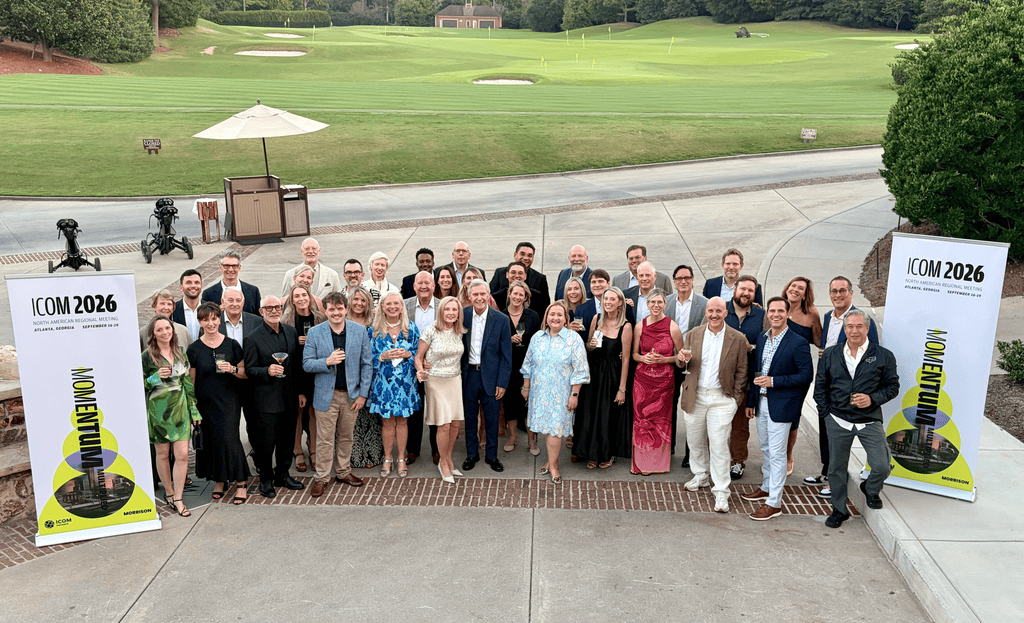
Rebuilding is easier together
Independent agencies don’t have a holding company’s research budget or central strategy team. What they can have is each other.
Across the ICOM network, that looks like a question one member asks becoming a session for many. A model one agency shares sparks another to rethink its pricing. A partner agency in another country becomes part of how the work gets delivered.
No one has found the finished agency model, and that may be the most useful lesson of all. The model will keep changing. The agencies best placed to keep up are the ones that stay curious, stay connected and keep comparing notes.
That is what ICOM is for. We connect to grow.