
June 23, 2026
What AI Looks Like Inside Independent Agencies Right Now
Perspectives from the ICOM World Meeting, Porto 2026
Editor’s note: Rob Scherzer, DNA&STONE; Miguel Pereira, Darwin & Verne; and Harry Moller, Provoking; members of the Global Artificial Intelligence Working Group within the ICOM Network, share their takeaways from the ICOM World Meeting hosted in Porto by member agency Wise Pirates.
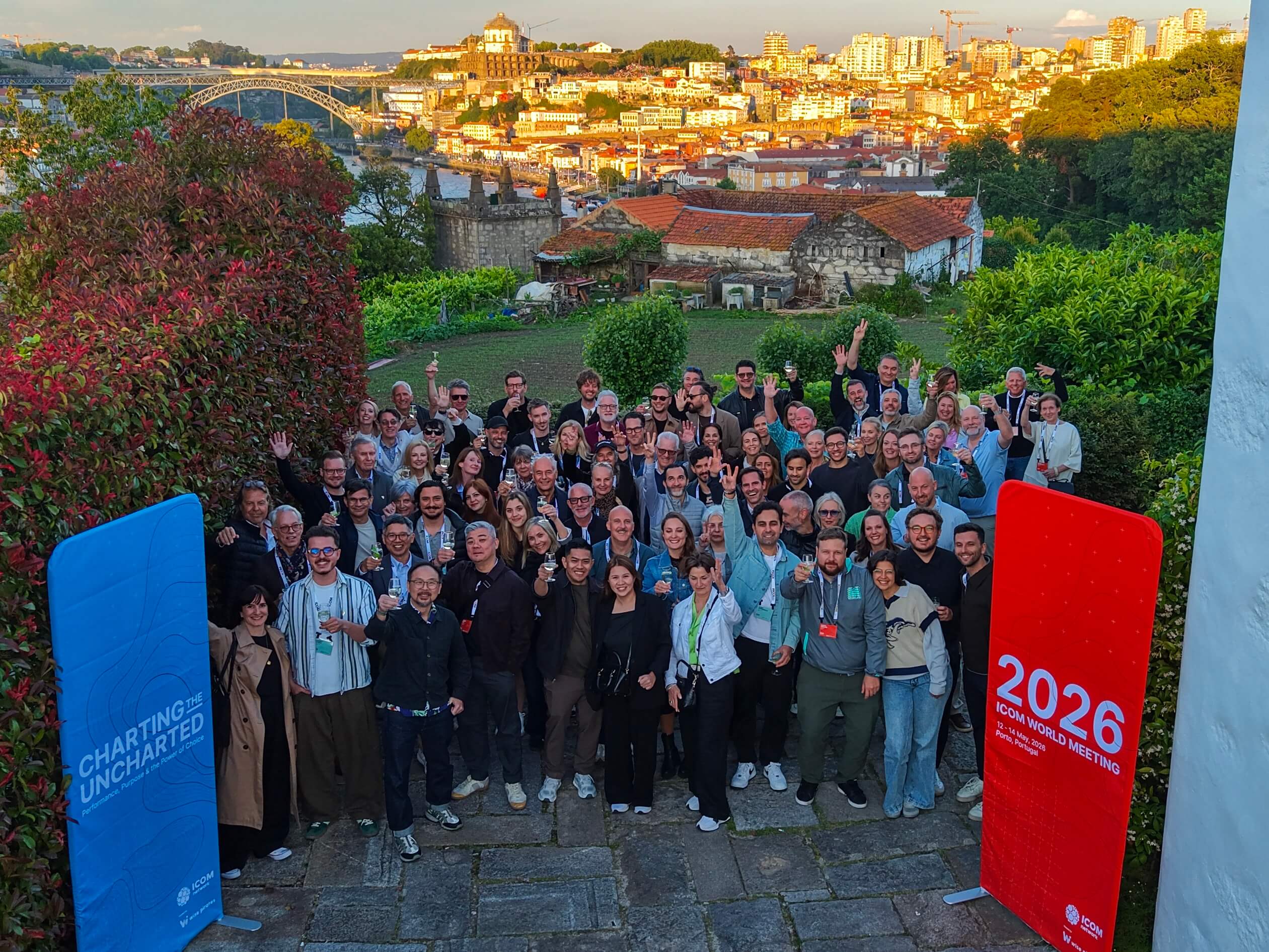
Midway through 2026, the question facing independent agencies isn’t whether to engage with AI. It’s how — and how fast, and in what order, and at what cost to the things that make your agency worth hiring in the first place.
AI wasn’t the only conversation at the ICOM World Meeting in Porto this May — but it kept finding its way back to the centre of the room. Three sessions brought in outside voices to push our thinking. What follows is what we took from them, filtered through what we’re seeing across the network right now. Not a conference recap. A read on where independent agencies actually stand.
Culture before tools
Neil Perkin, founder of Only Dead Fish in the UK, opened with a question most agencies haven’t yet asked themselves: before you build anything with AI, do you actually understand how your agency works?
His argument centres on what he calls the Agency Operating System: the operational and cultural infrastructure that sits beneath any technology decision. Most agencies, he observed, are investing in AI tools without building the foundation those tools need to run on. The result is adoption without integration: tools used in isolation, value captured inconsistently, and no scalable path forward.
The prescription isn’t complicated, but it requires discipline. Map how your team actually thinks and collaborates. Build genuine co-creation spaces with clients — not just approval workflows. Invest in your own assets: photography, illustration, tone of voice, visual systems. In a world where anyone can generate anything, the only real differentiator is what’s distinctly yours.
Design choices, he concluded, will always outlast technology choices. The agencies that lead won’t have the most sophisticated tools. They’ll have the sharpest judgment about when and how to use them.
It’s the conversation most agencies tiptoe around, and one the ICOM AI group keeps coming back to.
Honest about the learning curve
Bernardo Correia, Secretary of State for Digitalization to Portugal, brought a perspective that agencies rarely hear from a government figure: a frank acknowledgement that this is hard.
AI is changing the economics of work at a structural level — not just automating tasks, but fundamentally redefining what work costs, what it’s worth, and who gets to do it. That’s a significant disruption, and pretending it’s a smooth or universal transition sets organizations up to struggle unnecessarily.
His sharpest provocation: reinvent solutions before you reinvent your tools. The real leverage isn’t in automating the old answer — it’s in rethinking the problem itself. Most agencies are still skipping that step.
The agencies making genuine progress, he argued, tend to be the ones working under real constraints. Necessity still drives invention more reliably than budget does. And meaningful AI adoption spreads through people — through the changemakers inside an organization who build working examples that others want to follow — not through top-down mandates.
The measure of any AI implementation, he added, is whether the people using it feel more capable — not more replaceable. That’s a bar worth setting before the next tool purchase.
The capability he flagged as most underused was personalization. The ability to speak to individuals at scale, in ways that feel genuinely tailored rather than merely automated, is something no previous technology has made this accessible. Independent agencies — with deep client relationships, real contextual knowledge, and the agility to act on it — are positioned to use this better than almost anyone. That’s not a future opportunity. It’s a current one most are leaving on the table.
Build something every day
Rob Scherzer of DNA&STONE made the case that innovation is a daily practice, not a periodic event. A culture of innovation isn’t a policy or a workshop. It’s what happens when teams develop the habit of making and testing things — prototypes, prompts, experiments, sketches — consistently, at low stakes, without waiting for a perfect brief.
The bar doesn’t need to be high. What matters is that the muscle stays active.
His framing of AI as a one-on-one building conversation was one of the most useful reframes of the meeting. Not a platform, not a feature — a creative interlocutor that responds to how you think and how precisely you can articulate what you’re trying to solve. Which means the quality of what you get out of AI is a direct reflection of your creative clarity. Vague thinking produces generic results. Specific, well-considered thinking produces something worth keeping.
For independent agencies, that’s a structural advantage. Smaller, cohesive teams can develop a more distinct and consistent AI voice far faster than large organizations slowed by process and consensus. Agility here is a genuine competitive asset — one that independent agencies are built to use.
The pattern underneath
Three speakers, three entry points, one pattern. Culture before tools. Constraints over budgets. Daily practice over periodic ambition. The agencies moving fastest on AI aren’t waiting for the perfect conditions. Neither are we.